Bull Lake Road
Train DreamsBull Lake Road is the southbound route from Troy, Montana, toward Noxon, Montana, and it becomes the setting for an uneasy encounter between older horse transport, motor travel, and a proposed act of courtship. In the journey involving Robert Grainier, Eddie Sauer, and Claire Thompson, the road is less a destination than a working corridor: a passage along which a widow, her belongings, and two competing forms of transport are to be moved toward Sandpoint, Idaho.
Route and Setting
Bull Lake Road branches south from the road eastward out of Troy, Montana, and leads toward Noxon, Montana. Grainier and Eddie Sauer use it as part of their plan to travel from Troy to Noxon before continuing with the relocation of Claire Thompson. The route belongs to a landscape where roads still have practical, almost personal identities: Eddie refers to “road number Two Hundred,” as though its designation were self-evident, while Grainier proceeds by wagon and the automobile follows behind.
The road is therefore defined by movement rather than by civic prominence. Grainier reaches the rendezvous in Troy early in the morning, then heads east with his mares toward the Bull Lake route, keeping roughly half a mile ahead of Eddie Sauer. The distance is not merely a matter of convenience. Grainier’s horses dislike the automobile, and they also seem to dislike Eddie, so the road becomes a narrow zone in which animal temperament, human impatience, and mechanical noise must be managed together.
The Relocation Journey
The journey along Bull Lake Road arises when Eddie Sauer offers Grainier twenty-five dollars to help move Claire Thompson from Noxon, Montana, to Sandpoint, Idaho. Claire’s husband had died the previous summer, and she herself is not expected to pay for the move. Eddie’s motive is transparent: he hopes the assistance will advance his interest in the widow. Grainier supplies his mares and wagon, while Eddie uses his sister’s husband’s Ford Model T, modified by removing its rumble seat and adding a flat cargo bed.
That altered automobile is as precarious as the arrangement it carries. Its cargo bed must be loaded carefully so that the whole apparatus does not tip over. Along Bull Lake Road, the vehicle is not an unquestioned emblem of progress; it is an unstable contrivance that must be coordinated with horses, freight, and dusty rural travel. Grainier’s wagon and Eddie’s Ford Model T thus share the route without truly sharing its rhythm.
Horses, Automobiles, and Friction
The road exposes the sensory and practical conflict between the two conveyances. Grainier keeps ahead because his mares react badly to the automobile. When Eddie Sauer comes roaring up behind him, his horn squawking, the noise nearly stampedes the horses. Grainier walks back from the roadside and warns Eddie not to blast the horn around the mares, explaining that although they have seen every kind of commotion, they do not tolerate that particular sound.
The difficulty is compounded at an automobile filling station on the hill east of Troy. Heinz, a German operator, refuses to sell Eddie gasoline, a refusal connected to his hostility toward Eddie. Eddie responds by telling Grainier that the wagon must be taken back to buy two or three jugs of fuel. Bull Lake Road consequently links not only Troy and Noxon but also a chain of dependencies: the horses require calm, the Ford Model T requires gasoline, and the journey depends on cooperation among people who do not get along.
Narrative Significance
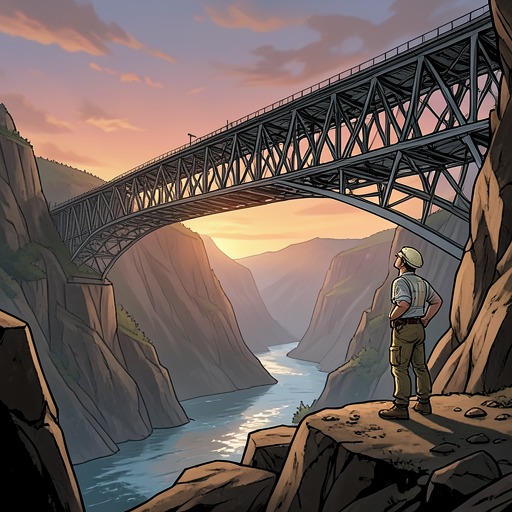
Bull Lake Road briefly concentrates the book’s larger history of transportation into one rural passage. Grainier’s life is repeatedly measured through railways, bridges, roads, automobiles, and eventually an aircraft. He has worked on the Eleven-Mile Cutoff Bridge and the Robinson Gorge Bridge, watched locomotives cross enormous wooden structures, and later rides in a biplane; the road journey shows a more ordinary scale of modernization, where a modified car must negotiate with horses rather than simply replace them.
The route also serves a social purpose. It carries Claire Thompson away from a household marked by bereavement and places her within Eddie Sauer’s unspoken hopes, while Grainier’s participation turns friendship and paid labor into the practical means of the move. Yet the road offers no smooth promise of modern convenience. Its traffic is slowed by animal fear, fuel shortage, personal antagonism, and the awkwardness of the improvised vehicle. Bull Lake Road thus appears as a material link between communities, but also as a place where technological change remains embodied, noisy, fragile, and dependent on older forms of labor.